
New Delhi: Researchers have developed a breakthrough method to boost the performance of Coordination Polymer Electrocatalysts, offering a significant advancement in clean hydrogen production.
The discovery addresses long-standing challenges in the oxygen evolution reaction (OER), a critical step in water electrolysis.
The oxygen evolution reaction has traditionally posed difficulties due to slow kinetics and high overpotential demands when compared to the hydrogen evolution reaction (HER).
As a result, developing efficient, noble-metal-free catalysts remains a key research priority. Coordination Polymer Electrocatalysts, created by linking metal ions with organic molecules, have been widely used but often suffer from low availability of active catalytic sites.
Also Read: Bengaluru: CeNS Researchers Create Flexible Aluminum Battery Technology as Lithium-Ion Alternative
Plasma Activation Boosts Coordination Polymer Electrocatalysts
Scientists at the Centre for Nano and Soft Matter Sciences (CeNS), Bengaluru – an autonomous institute under the Department of Science and Technology (DST) – have introduced an innovative solution to this limitation.
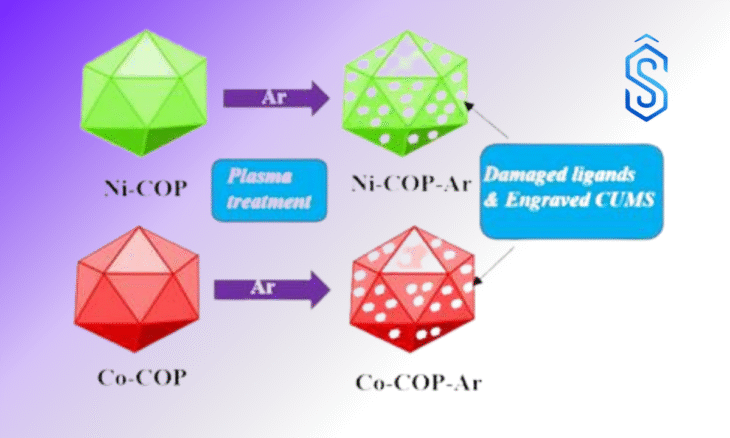
They used argon plasma treatment to activate coordination polymers by generating coordinatively unsaturated metal sites (CUMSs), significantly improving catalytic activity without disturbing the bulk polymer structure.
Validation Through Advanced Structural Studies
Comprehensive structural analysis showed that newly developed nickel- and cobalt-based Coordination Polymer Electrocatalysts remained consistent across single-crystal and bulk powder X-ray diffraction (XRD) studies.
While the original materials exhibited high onset potentials and poor OER activity in alkaline media, the plasma-treated versions demonstrated sharp improvements.
Also Read: INST Mohali Researchers Develop Gold Nanoclusters-Based Parkinson’s Detection Tool
The creation of unsaturated metal sites through plasma activation was confirmed through powder XRD, transmission electron microscopy (TEM), X-ray photoelectron spectroscopy (XPS), and contact angle measurements. Throughout the process, the overall polymer framework remained intact.
Improved Electrocatalytic Performance for Water Splitting
The plasma-modified Ni- and Co-based coordination polymers showed remarkable enhancements in electrocatalytic performance, highlighting their potential as cost-effective and efficient catalysts for water splitting.
Published in ACS Applied Nano Materials, the study presents a practical method for improving the intrinsic activity of Coordination Polymer Electrocatalysts while preserving structural stability. This approach is expected to support ongoing efforts toward scalable, affordable clean hydrogen production.